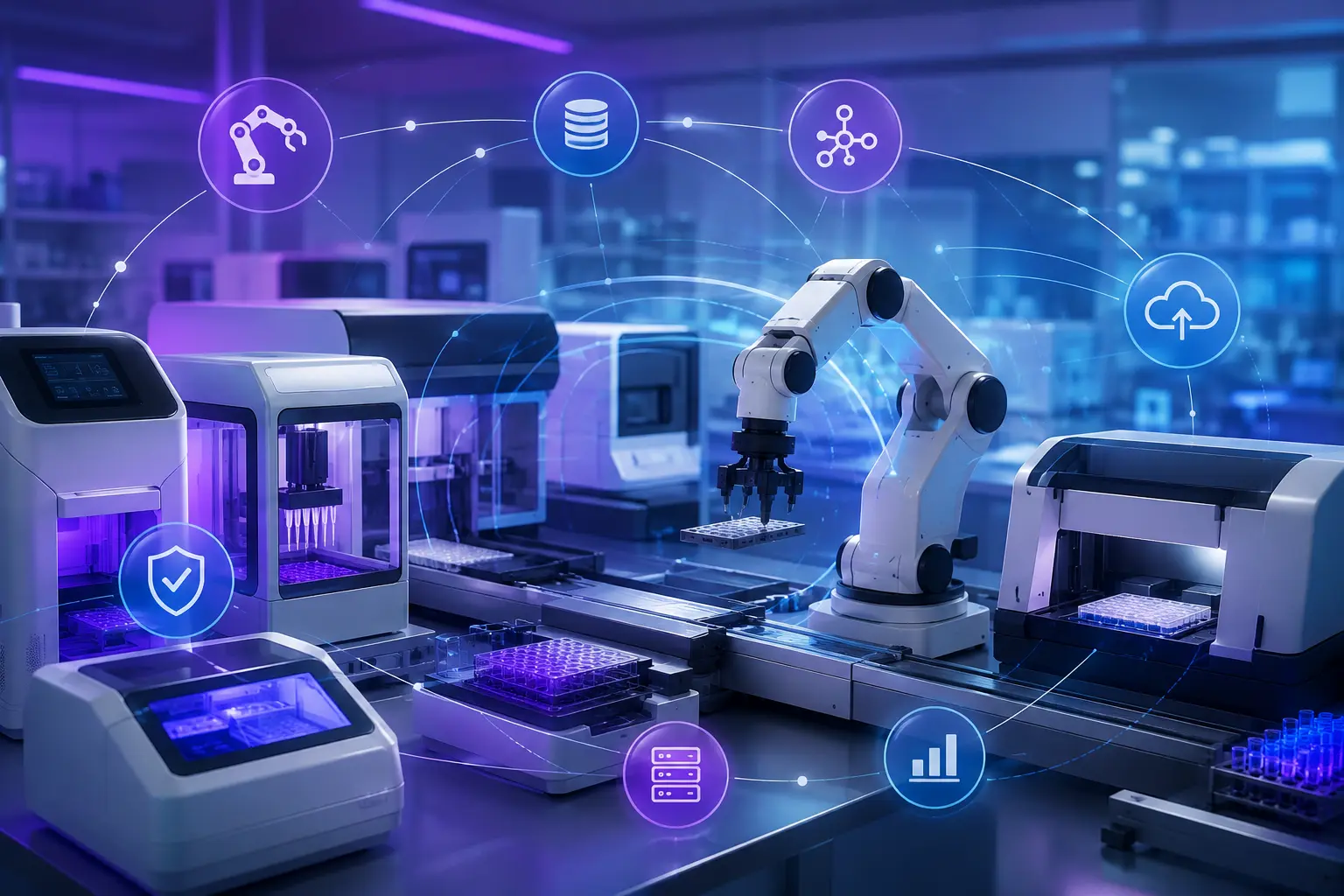
Compressed Instrument Onboarding
The organization compressed new instrument onboarding timelines from 6 weeks down to less than 1 day, enabling rapid integration of new devices as simple configuration steps rather than bespoke software builds.
Client: Tier-1 Biopharmaceutical R&D Organization
Location: United States
Industry: Life Sciences & Automated Diagnostics
As lab-automation hardware commoditizes, the primary operational bottleneck in life sciences R&D has shifted from physical robotics to the software orchestration layer. High-throughput laboratories routinely operate heterogeneous hardware from multiple manufacturers. Connecting a liquid handler from one vendor to a plate reader from another—and linking both to a LIMS—typically requires bespoke, per-instrument driver engineering.
When a biopharmaceutical research lab expanded its automated screening pipeline, new instruments from different vendors caused severe workflow fragmentation. Every firmware update broke custom interface scripts, halting automated runs and forcing engineers to spend hours rewriting drivers instead of advancing scientific experiments. "The robotics were capable and affordable, but our automation goals were stalled because the instruments couldn't talk to each other without custom software projects every single time," noted the Lead Automation Engineer.
Custom Driver Technical Debt: Connecting multi-vendor instruments required fragile, bespoke API integration scripts for each device pairing.
Brittle Workflows & Firmware Failures: Vendor firmware updates regularly broke custom connections, causing unplanned downtime and lost experiment runs.
Siloed & Incompatible Data: Proprietary data formats across devices prevented real-time monitoring and blocked AI-driven closed-loop orchestration.
Vendor Lock-In Risk: Dependence on proprietary hardware ecosystems forced trade-offs between selecting best-of-breed instruments and maintaining workflow connectivity.
Engineers implemented native SiLA2 (Standardization in Lab Automation) microservices to give instruments discoverable, network-based control interfaces. For legacy equipment, lightweight containerized edge adapters were deployed to convert proprietary REST APIs, serial/TCP data, and drop-file interfaces into standardized SiLA2 Feature Definitions.
The team built an asynchronous scheduling engine to sequence complex multi-device handoffs (e.g., Liquid Handler → Transporter Arm → Microplate Reader). Real-time state-machine validation was integrated to detect interface drift, version mismatches, and execution errors instantly.
The platform automatically normalizes raw instrument outputs into ontology-annotated, FAIR-compliant (Findable, Accessible, Interoperable, Reusable) data structures. Standardized data streams flow directly into downstream LIMS and AI design loops in real time.
A responsive web application was implemented to provide automation leads with real-time fleet health visibility, active workflow state tracking, and rapid exception resolution without requiring custom code patches.
The organization compressed new instrument onboarding timelines from 6 weeks down to less than 1 day, enabling rapid integration of new devices as simple configuration steps rather than bespoke software builds.
Driver maintenance workload dropped by over 90%, freeing 18+ technologist hours per lab cell weekly that were previously lost to repairing broken scripts caused by firmware updates.
By decoupling workflow orchestration from specific hardware vendors, the lab eliminated firmware-induced downtime and unlocked real-time closed-loop DMTA (Design-Make-Test-Analyze) workflows.
Automated FAIR data mapping ensured that 100% of generated experimental data became immediately available for downstream AI models and informatics systems, accelerating the path to autonomous experimentation.
Traditional instrument vendor software locks labs into specific hardware ecosystems, while LIMS platforms manage sample records without solving real-time, low-level device control. Systems integrators hand-build custom connections, accumulating technical debt that breaks with every firmware release.
This platform acts as a vendor-agnostic operating system for the lab bench. By anchoring device control to the open SiLA2 standard and translating proprietary interfaces at the edge, it creates a universal control and data layer. It allows labs to compose best-of-breed hardware into maintainable, automated workflows without committing to a single vendor's ecosystem.
By shifting from bespoke driver integration to open, standardized orchestration, the biopharmaceutical organization transformed its automated laboratory operations. The platform eliminated driver maintenance tax, protected workflows from firmware breaks, and created an AI-ready data foundation.
Establishing a vendor-neutral connective layer allows research facilities to scale automation throughput without increasing engineering overhead. Organizations that unify heterogeneous instruments under a standardized orchestration middleware protect their technology investments, lower operational downtime, and accelerate the shift toward truly autonomous experimentation.
We act as a global catalyst for change, empowering our clients and partners to leverage technology, unlock growth, achieve sustainability, and bolster capabilities. See how our clients benefited from our partnerships.