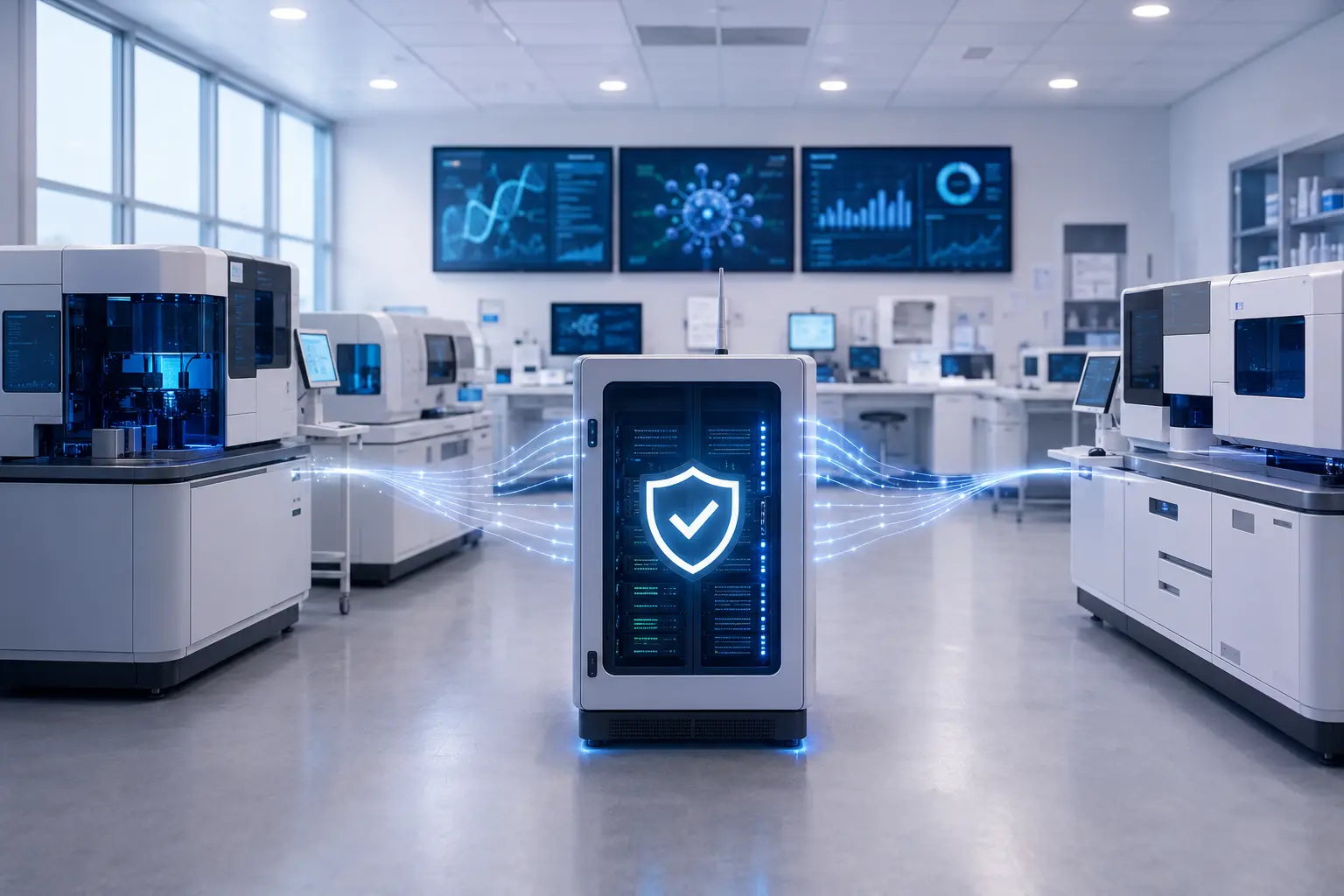
Compressed Integration Timelines
The health system compressed instrument integration timelines from 9 months down to 3 weeks, clearing the IT security queue and bringing all six molecular analyzers live ahead of schedule.
Client: Multi-Site Hospital Network & Reference Laboratory
Location: United States
Industry: Clinical Diagnostics & Healthcare IT
Health systems invest millions in diagnostic instruments, only to face an integration bottleneck: connecting them to Laboratory Information Systems (LIS) and Electronic Health Records (EHR). Because in-vitro diagnostic (IVD) vendors use custom ASTM or HL7 dialects and lack enterprise IT security documentation, new deployments trigger 6-to-9-month vendor security reviews.
When a health system acquired six molecular sequencers, the hardware sat idle for seven months waiting for interface scripts and CISO sign-off. Technologists manually programmed sample IDs and transcribed test results from screens into the LIS. "We had $3 million in diagnostic hardware sitting on the bench while techs keyed in runs by hand," noted the System Director of Pathology Informatics.
6-to-9-Month Security Delays: Unvetted vendor endpoints and a lack of SOC 2 or ISO compliance stalled deployments in hospital IT risk queues.
Bespoke Protocol Dialects: Non-standard ASTM E1381/E1394 and HL7 v2 variants required custom, fragile transformation scripts for each analyzer model.
Manual Transcription Errors: Technologists spent over 15 hours weekly hand-keying orders and transcribing results, risking clinical entry errors.
Stranded Capital: High-value diagnostic equipment sat idle, delaying billable testing volume and burning operational capacity.
Engineers deployed a containerized agent within the local network (DMZ). Pre-packaged with a Compliance Acceleration Kit (SOC 2 Type II, ISO 27001, HECVAT, and real-time SBOMs), the agent passed the CISO audit in under 21 days without exposing Patient Health Information (PHI) to external clouds.
The team built a pipeline to parse legacy serial/TCP ASTM data and proprietary HL7 v2 dialects. The engine normalizes test codes to LOINC, units to UCUM, and maps custom OBX/OBR segments into standardized FHIR R4 and USCDI v3 resources.
Using Apache Kafka and Redis Pub-Sub, the platform handles high-burst instrument data flows without dropping payloads. The queuing engine features automated retry logic, deterministic fallback queues for unmapped fields, and an immutable CLIA audit log.
A dashboard built with Next.js and React provides lab managers with real-time fleet health monitoring, data flow alerts, and rapid mapping tools, replacing multi-day IT troubleshooting with instant exception handling.
The health system compressed instrument integration timelines from 9 months down to 3 weeks, clearing the IT security queue and bringing all six molecular analyzers live ahead of schedule.
Automating order feeds and result reporting eliminated over 95% of manual transcription touchpoints, recovering 60+ technologist hours per month and removing manual entry errors from the clinical workflow.
By accelerating revenue realization on high-throughput test panels, the health system unlocked over $1.2M in stranded operational capacity within two quarters.
The IVD manufacturer co-selling the platform reduced sales cycle friction by 70%, establishing a compliance-ready deployment model across future accounts.
Traditional interface engines handle basic transport plumbing but lack pre-built, instrument-specific parsing logic, requiring custom engineering for every new analyzer model. LIS and EHR systems sit at the endpoints but do not own protocol translation or security friction in between.
This platform functions as an analyzer-agnostic translation and security shield. Operating within the health system's secure enclave, it normalizes legacy instrument dialects into standardized FHIR/HL7 streams while satisfying enterprise security requirements out of the box. It turns a multi-month IT integration project into a plug-and-play appliance.
By decoupling hardware deployment from lengthy IT security reviews and protocol engineering, the health system transformed its diagnostic operations. The platform cleared the compliance gate, automated data flows, and eliminated manual bench work, turning idle hardware into active revenue engines.
Unifying legacy and modern instruments under a single translation layer allows diagnostic facilities to scale testing volume without increasing administrative friction. Organizations that solve the integration and security bottleneck protect operating margins, accelerate time-to-revenue, and deliver critical diagnostic data without delay.
We act as a global catalyst for change, empowering our clients and partners to leverage technology, unlock growth, achieve sustainability, and bolster capabilities. See how our clients benefited from our partnerships.