Reduced Overtime Costs
The laboratory cut weekly overtime spend by 78% in the first quarter as technologists reclaimed over 40 hours per month previously lost to manual fridge counts and spreadsheet tracking.
Client: Mid-Sized Reference Laboratory
Industry: Clinical Diagnostics & Life Sciences
Focus: Laboratory Supply Chain Automation & Predictive Reordering
Clinical labs face a structural staffing deficit of 20,000 to 25,000 professionals across the US and Canada. With shrinking training pipelines and high retirement rates, labs cannot hire their way out of the gap. Meanwhile, scarce technologists spend hours each shift manually counting inventory, logging lot numbers, and chasing purchase order approvals.
When a mid-sized reference lab operated two full-time positions short for eight months, technologists spent their first hour every shift auditing reagent fridges instead of running assays. "We were paying senior technologists overtime rates just to count boxes and reconcile spreadsheets," noted the Laboratory Operations Director. Unrecorded stock usage caused sudden stockouts, expensive rush shipments, and repeated test runs from expired reagents.
Manual Fridge Audits: Senior technologists lost over 10 hours weekly conducting manual fridge audits and tracking lot expiration dates across paper logs.
Unplanned Stockouts: Unplanned stockouts forced frequent rush orders at premium shipping rates to avoid pausing diagnostic test menus.
Inventory Drift: Disconnected software created inventory drift between physical stock levels, spreadsheets, and Laboratory Information Management System (LIMS) records.
Reconciliation Overhead: Month-end purchasing reconciliation required two full days of administrative overtime to resolve variances between orders, bills, and actual usage.
Engineers built an ingestion layer using FastAPI and custom parsers to connect the platform directly to existing LIMS, procurement portals, and diagnostic hardware. The system ingests run logs, receiving scans, and supplier catalogs via REST APIs and WebSocket feeds. This approach enabled continuous material usage tracking directly from instrument runs without changing bench workflows or replacing core software.
The team configured a Python and PostgreSQL backend to track reagents, calibrators, and consumables at the lot level. Depletion logic calculates precise consumption per test step rather than tracking basic unit counts. The system updates on-hand quantities automatically in the database as tests complete.
Background workers powered by Celery and Redis calculate rolling consumption baselines to adjust reorder points dynamically based on supplier lead times. Automated rule logic monitors lot expiration dates and open-container stability windows. The system generates draft purchase orders for manager approval and flags near-expiry lots before technicians load them onto instruments.
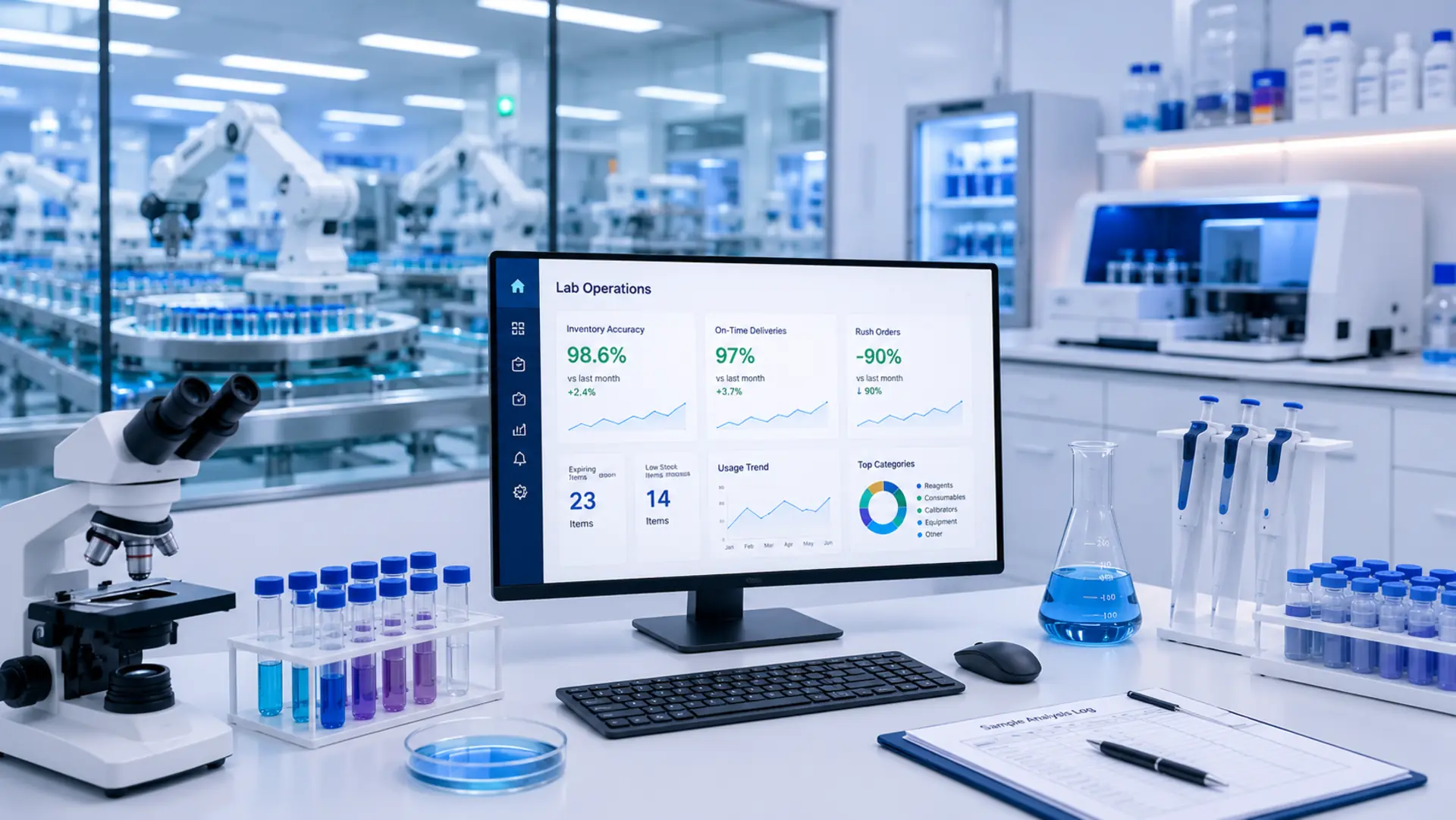
The platform continuously cross-references purchase orders, receiving logs, instrument runs, and vendor invoices. Discrepancies trigger targeted exception alerts in a React and Next.js interface, replacing multi-day manual reconciliation scrambles with automated audit trails aligned to FDA 21 CFR Part 11 guidelines.
The laboratory cut weekly overtime spend by 78% in the first quarter as technologists reclaimed over 40 hours per month previously lost to manual fridge counts and spreadsheet tracking.
Redirecting these hours back to diagnostic testing effectively absorbed the workload of the two vacant positions without adding headcount.
Automated stability tracking dramatically reduced reagent waste by preventing technicians from loading expired lots onto instruments, while predictive reordering brought emergency rush-order fees down to near zero.
Month-end financial reconciliation transformed from a multi-day ordeal into a brief administrative review, giving leadership immediate visibility into operational expenses.
Traditional LIMS manage sample lifecycles, while Electronic Lab Notebooks document scientific results. Neither system handles the operational loop between purchasing, lot-level consumption, and usage reconciliation. Generic inventory software lives in a separate silo, leaving staff to bridge operational gaps manually.
This platform operates as an orchestration layer sitting directly on top of existing infrastructure. By deriving material usage directly from instrument run data, it automates tracking without asking the lab to re-platform. It turns hidden operational waste into a clear financial metric, letting facilities recover capacity through targeted software automation.
By shifting focus from hiring to process automation, the laboratory stabilized its daily operations. The platform eliminated manual inventory checks, reduced overtime spend, and prevented reagent waste, converting invisible logistics work into an automated background process.
Reclaiming technician hours allowed the facility to maintain testing throughput despite a tight labor market. Laboratories that automate routine supply chain coordination protect their operating margins, lower burnout, and keep staff focused on scientific work.
We act as a global catalyst for change, empowering our clients and partners to leverage technology, unlock growth, achieve sustainability, and bolster capabilities. See how our clients benefited from our partnerships.