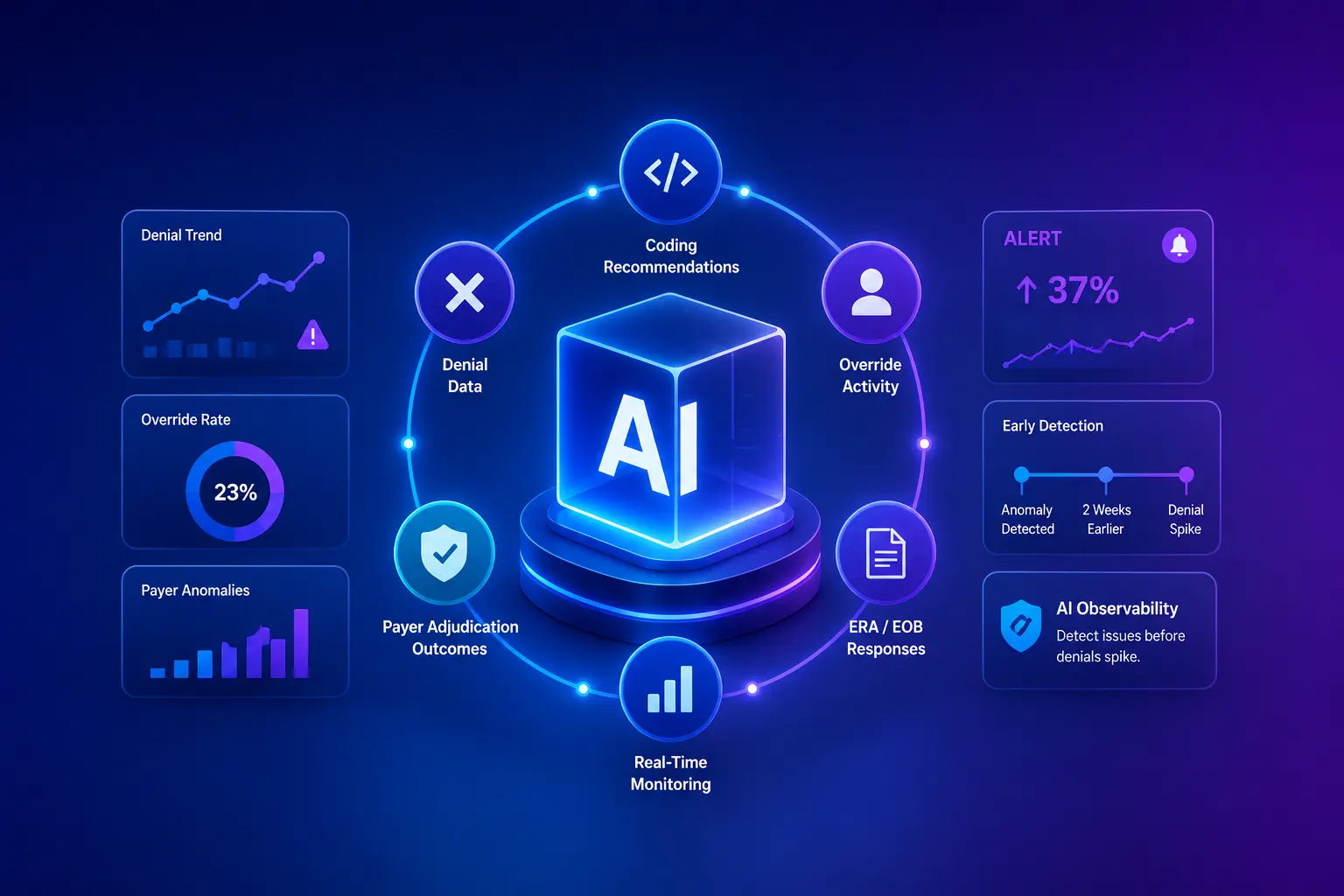
Faster Anomaly Detection
The platform helped the client identify reimbursement drift nearly three weeks earlier than their previous workflow, reducing operational exposure significantly.
Client: US-based Revenue Cycle Management Provider
Location: United States
Industry: Healthcare Revenue Cycle Management
The client had already adopted AI-assisted medical coding to improve claim throughput and reduce manual workload. Initially, the results looked strong. Claims moved faster, coders handled higher volumes, and leadership became increasingly confident in automation.
Then denial rates started rising. Not suddenly. Quietly. Coders began overriding AI recommendations more frequently. Modifier-related denials increased. Reimbursements slowed down. The problem was difficult to detect because the AI recommendations still looked correct on the surface.
According to the 2024 CAQH Index, administrative inefficiencies continue to cost the U.S. healthcare system billions annually, with denial management remaining a major operational burden. At the same time, healthcare organizations are rapidly increasing AI adoption across revenue cycle workflows.
The client realized they lacked one critical capability: Visibility into whether their AI coding system was still aligned with changing payer behavior.
As one billing operations manager explained: "The AI wasn't obviously broken. That's what made it dangerous."
Silent AI coding degradation: Payer reimbursement rules changed faster than the AI model adapted, causing denial rates to increase gradually without triggering immediate alarms.
No real-time monitoring for coding drift: Existing dashboards only showed high-level denial trends and failed to connect override behavior, payer anomalies, and coding performance issues.
Lean operational teams: The client lacked dedicated analytics or MLOps resources to continuously monitor AI performance across billing workflows.
Reactive vendor escalation: The billing team struggled to prove when AI coding quality declined because they lacked measurable operational evidence.
Instead of replacing the client's coding platform, we built a lightweight observability layer on top of the existing workflow.
The system continuously monitored:
This allowed the client to track operational trust signals instead of relying only on static coding accuracy metrics.
We identified override behavior as an early indicator of coding drift.
The platform tracked:
The system detected a 23% increase in overrides tied to one payer category nearly two weeks before denial spikes became operationally visible.
"Our coders knew something felt off. We just couldn't measure it before."
— Revenue Cycle Lead
We built a monitoring engine that continuously analyzed:
When abnormal behavior emerged, the system triggered automated alerts.
Example alert: "Modifier 25 denial rates for Payer X increased 37% above baseline. Associated override activity increased 21%. Potential coding drift detected."
This reduced investigation timelines from weeks to days.
Before implementation, vendor escalations were largely anecdotal.
We built automated reporting workflows that generated:
The client could now escalate issues with measurable evidence instead of assumptions.
"The platform gave us proof instead of suspicion."
— Operations Manager
The platform helped the client identify reimbursement drift nearly three weeks earlier than their previous workflow, reducing operational exposure significantly.
The billing team gained earlier denial risk visibility, enabling proactive intervention before reimbursement began to deteriorate.
Automated reporting workflows equipped the billing team with measurable evidence, enabling stronger and more defensible vendor escalations.
According to HFMA denial management benchmarks, even small reductions in denial exposure can materially improve reimbursement timelines for SMB billing organizations. As one billing director explained: "The real win wasn't catching denials faster. It was catching AI drift before reimbursement started bleeding everywhere."
Most healthcare AI vendors focus on automation speed and coding accuracy. Very few focus on post-deployment observability. That's the gap we solved.
We approached AI coding systems like production infrastructure that requires continuous monitoring, not static software that can be deployed and ignored. As payer rules, modifier requirements, and reimbursement behavior evolved, the platform continuously surfaced operational anomalies before denial trends became financially damaging.
This created a new operational layer for healthcare AI systems: Real-time AI observability for revenue cycle management.
Healthcare organizations are rapidly adopting AI across coding and reimbursement workflows. But automation without monitoring creates operational risk.
For this client, the challenge wasn't generating coding recommendations. The challenge was knowing when those recommendations stopped aligning with real-world payer behavior.
By building a healthcare AI observability platform tailored for SMB billing teams, we helped the client detect coding drift earlier, respond faster, and reduce reimbursement risk before denials escalated.
The next phase of healthcare AI won't just be about automation. It will be about operational trust.
We act as a global catalyst for change, empowering our clients and partners to leverage technology, unlock growth, achieve sustainability, and bolster capabilities. See how our clients benefited from our partnerships.